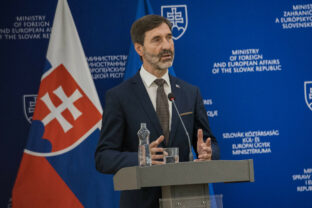
BRATISLAVA, January 31, (WEBNOVINY) — In a draft report on fulfillment of tasks for 2010 that has been submitted for interdepartmental review, the Slovak Ministry of Foreign Affairs states that last year marked a positive turning point for Slovakia’s diplomacy. “A qualitative change after the new government took over was mostly registered in advancement of a realistic view on functioning of the European Union and its currency, in change in the atmosphere in relations with Hungary and accomplishing a value-based foreign policy,“ reads the material. Economic policy abroad focused on overcoming the consequences of the global economic crisis. The agenda of commercial attaches came under the Ministry of Foreign Affairs from this year. The most visible part of foreign policy is consular service and its important component, Foreign Affairs Center for Assistance and Services for Citizens, which provided citizens with almost 8,000 pieces of information over the phone last year. In 2010, the Foreign Affairs Ministry signed agreements with Hungary and Slovenia, which would act on behalf of Slovakia in provision of consular assistance and issuance of visas in countries where Slovakia does not have representation, reads the report.
Among other, the National Convent project started with support of the Slovak development aid in December. Slovakia’s diplomatic mission in Kiev has served for the fourth year as a NATO contract embassy in Ukraine. “The year of 2010 brought a change in Slovak-Hungarian relations after the confrontational and non-productive period. It was only at July meeting of prime ministers of new governments when an agreement on seeking solutions to problematic issues was concluded, bilateral dialogue was resumed and mixed commissions were put back into operation,“ reads the material.
Slovakia commenced an active dialogue with the European Commission and countries of the region, which are to be part of the EU Danube Strategy. The material marked relations with the Czech Republic as above-standard and those with Poland as dynamic. Traditional topic of nuclear energy stood out in mutual relations with Austria. With Ukraine, the Slovak diplomacy pursued economic ties, energy security, minority and compatriot issues, and cross-border cooperation.
The government intends to deepen bilateral cooperation with the USA and boost cooperation with Germany. Slovakia and Great Britain mostly engaged in issues of European policies in 2010. Essence of bilateral relations with France was bolstering mutual dialogue, EU topics prevailed in talks with Spain, and bilateral relations with Italy focused on increasing quality of investment opportunities in Slovakia. In relations with Portugal, Belgium, Luxembourg, Greece, Sweden, Cyprus, Denmark, Finland and the Netherlands, seeking more opportunities of deeper economic and cultural cooperation were addressed. Slovakia continued advancing pragmatic and mutually beneficial relations focused on the economic area and strengthening of economic dimension in relation with the Russian Federation.
Financial crisis was the central topic on the European agenda in 2010. “Slovakia sought adopting measures that would lead to more permanent solution to the problem in its decision-making on a loan to Greece and establishment of the European Financial Stability Facility. Slovakia promoted different view of the solution to indebted countries in the eurozone and acknowledgment that a loan would not help unless the essence of the problem is cured. Slovakia’s stance contributed to the change in this optics although it was subject of sharp criticism at first. Slovakia’s viewpoint later proved to be well-founded, value-based and perspective,“ claims the ministry in its report.
SITA